
2026 Checklist: Is Your Building Portfolio Ready for the Revised EPBD Requirements?
The revised Energy Performance of Buildings Directive (EPBD) is accelerating the shift toward more energy-efficient and digitally managed buildings across Europe. As EU member states begin implementing the updated framework over the coming years, expectations around automation, monitoring, and operational performance are becoming increasingly important for property owners.
As implementation will vary between EU member states, timelines and specific requirements may differ across markets. However, the overall direction is clear: buildings are expected to become more adaptive, efficient, and data-driven.
For many real estate companies, this means that traditional building operations based on fixed schedules and manual adjustments may no longer be enough to support future efficiency and decarbonization targets. Instead, the focus is moving toward continuous monitoring, smarter control strategies, and better use of real-time operational data.
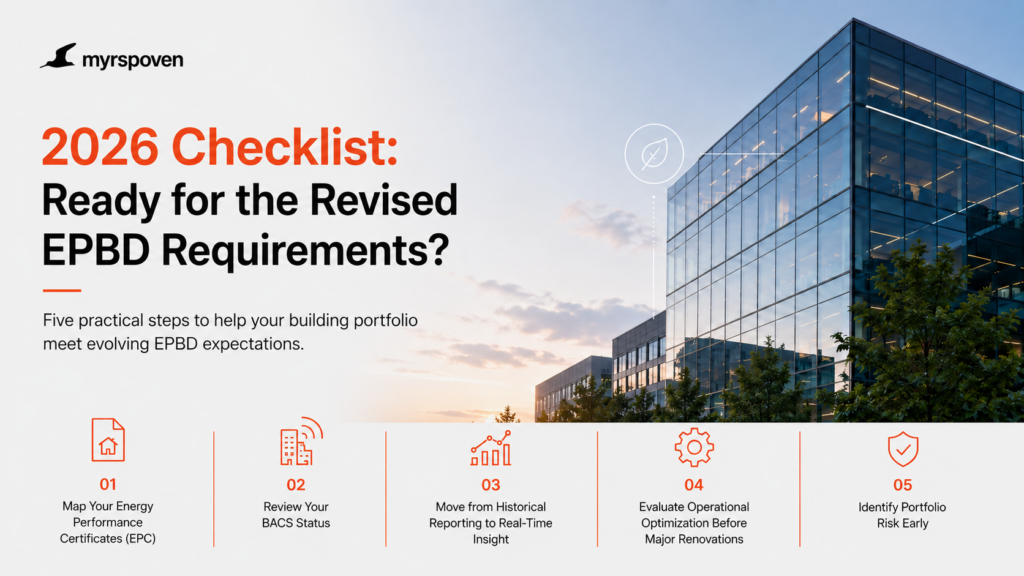
Here are five areas worth reviewing to prepare your portfolio for the next phase of the EPBD transition.
5 Steps Towards a More Future-Ready Portfolio
1. Map Your Energy Performance Certificates (EPC)
The revised EPBD places increasing attention on improving the performance of inefficient buildings across Europe.
Strategic Step:
Identify which properties in your portfolio fall into lower EPC classes, particularly E, F, or G. Depending on asset type and national implementation, lower-performing buildings are likely to face increasing pressure for upgrades and operational improvements in the coming years.
You can find more information about EPC classifications through your local regulatory authority.
2. Review Your Building Automation and Control Systems (BACS)
For many larger commercial and non-residential buildings, Building Automation and Control Systems (BACS) are becoming an increasingly important part of compliance and operational efficiency strategies.
The revised EPBD framework highlights the role of systems that can:
- continuously monitor technical performance,
- identify inefficiencies,
- support adaptive control,
- improve operational transparency.
The growing focus on building intelligence and operational responsiveness is also reflected in initiatives such as the Smart Readiness Indicator (SRI), which aims to measure how effectively buildings adapt to occupant needs, optimize energy use, and interact with the grid.
Strategic Step:
Evaluate whether your current systems do more than simply collect data. Can they support ongoing optimization and actionable operational insights in real time?
For many property owners, the next step is not replacing existing infrastructure, but making better use of it through more intelligent and responsive control strategies.
3. Move from Historical Reporting to Real-Time Insights
Energy reporting is gradually shifting from static historical analysis toward more continuous and operationally relevant data.
Strategic Step:
Review how accessible and granular your building data is today. Can you extract hourly operational data? Can you demonstrate measurable improvements over time?
If not, it may be time to strengthen the digital infrastructure connecting your building management systems (BMS), meters, and operational platforms.
Many portfolios still struggle with fragmented building systems and inconsistent data quality, making operational decision-making more difficult than it needs to be.
4. Evaluate Operational Optimization Before Major Renovations
Physical renovations remain important, but operational improvements can often deliver faster results with lower investment requirements.
Strategic Step:
Before initiating larger capital-intensive projects, assess the potential of software-based optimization and AI-supported control strategies. In many cases, existing HVAC systems can operate significantly more efficiently when adjusted dynamically based on occupancy, indoor climate conditions, and weather forecasts.
This can help reduce unnecessary energy use while maintaining tenant comfort and extending the value of existing building infrastructure.
5. Identify Portfolio Risk Early
As sustainability expectations continue to influence financing, tenant requirements, and asset valuation, operational energy performance is becoming increasingly strategic.
Strategic Step:
Conduct a portfolio-level assessment to identify which buildings may require operational improvements or modernization efforts over the coming years.
Early action can help reduce future compliance risk while strengthening competitiveness in a market where energy performance is becoming a larger part of long-term asset value.
Why Digital Optimization Matters
Real-world operational data shows that smarter control strategies can significantly reduce unnecessary energy use without requiring extensive physical renovations.
In Myrspoven managed properties, AI-driven HVAC optimization has contributed to measurable reductions in energy consumption while maintaining tenant comfort and existing building infrastructure. In one office property in Prague, AI-supported optimization helped reduce energy consumption without requiring major physical renovations.
Technologies that adapt building operations based on weather conditions, occupancy patterns, and indoor climate needs are becoming an increasingly important part of modern property management.
For property owners, the challenge is no longer only about collecting data, it is about turning data into operational action.
Summary
The revised EPBD is not only a regulatory shift, but also a signal that operational efficiency and digitalization are becoming central parts of modern real estate management.
Property owners that begin preparing now will be better positioned to:
- improve energy performance,
- reduce operational costs,
- support sustainability goals,
- strengthen long-term asset value.
Myrspoven helps property owners optimize building operations through AI-driven control and real-time analysis, enabling more efficient HVAC performance without disrupting tenants or requiring major hardware replacements.
Sources:
Further Reading:
About Myrspoven
Myrspoven AB is a pioneering force within energy optimization, dedicated to revolutionizing the way buildings harness and consume energy. With a deep commitment to sustainability, Myrspoven leverages cutting-edge AI technology and innovative solutions to create more efficient buildings, consuming less energy, as well as contributing to more sustainable and stable energy systems.